How the film is shot: long lenses, real corridors, very little score.
The Making · 4 min read · 3 sections
The cinematography of The Interpreter works against spectacle — and that restraint is exactly what gives the film its unease.
§01Compression Without Claustrophobia
Darius Khondji was the director of photography on The Interpreter, and his approach to the film's visual language begins with a single discipline: keep the camera off the action. Long lenses dominate the shooting style throughout — telephoto focal lengths that compress space, flatten depth and hold a particular kind of distance between the viewer and the person being observed. This is not accident or aesthetic fashion. It is the film's subject rendered in light.
Silvia Broome is an interpreter. Her entire professional life is organised around the duty to be invisible — to transmit meaning without adding any, to be present without being noticed. Tobin Keller is an investigator. His job is to watch, to wait, and to doubt what he sees until he has exhausted every alternative. Put these two people in a building full of corridors, glass partitions and observation galleries, and then shoot them with lenses that seem to be watching from across the room, and the film's formal argument emerges without a word of exposition: everyone here is observed, and none of them entirely trusts the frame they are seen through.
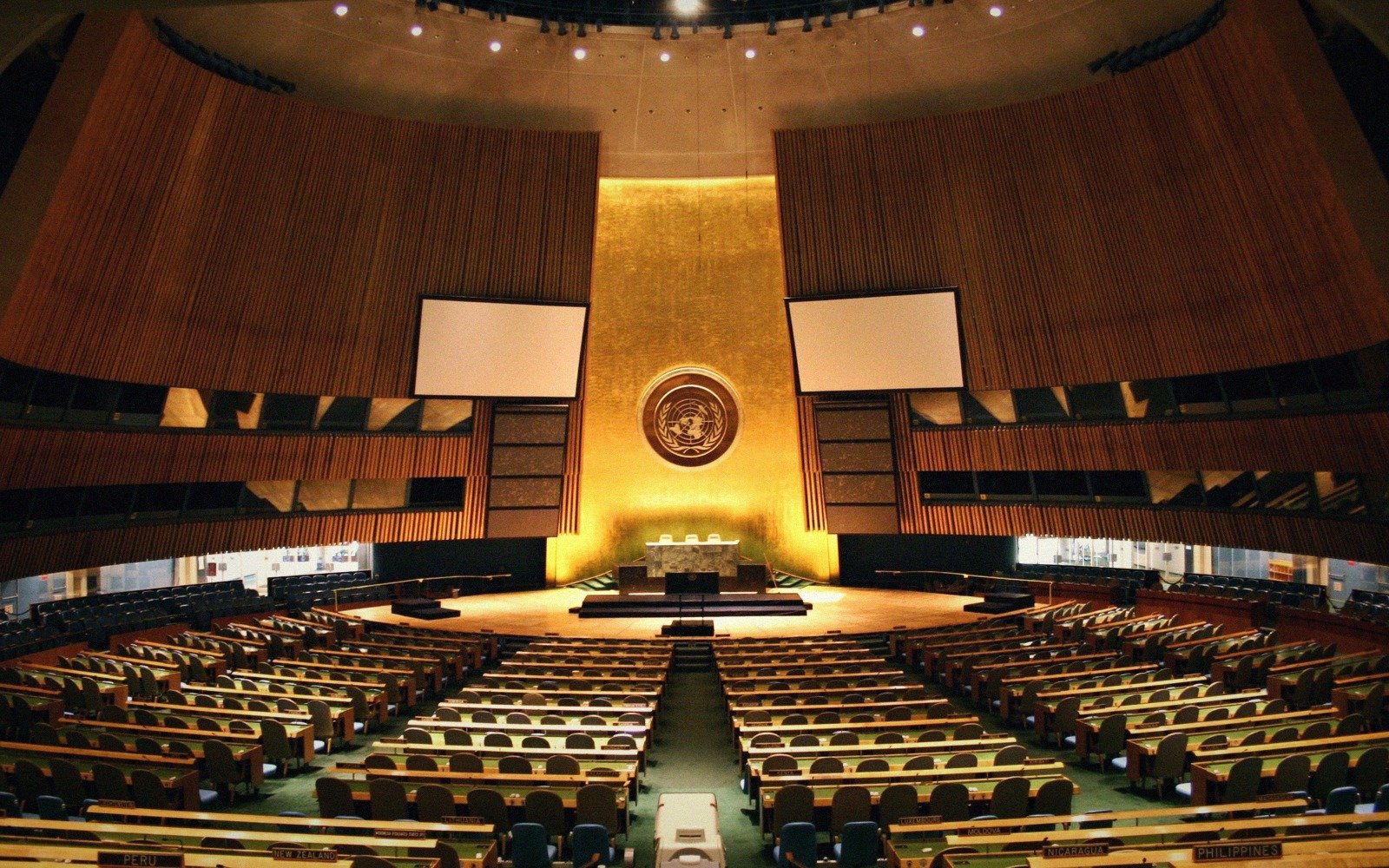
The United Nations Headquarters1 itself reinforced this visual logic. The permission Sydney Pollack2 secured to shoot inside the actual building gave the production access to real corridors, the genuine General Assembly3 chamber, and working spaces whose architecture had never been designed for drama. This was not a studio recreation, and it shows — not through grandeur but through a kind of institutional flatness. The ceilings are correct. The light comes from the wrong angles. The rooms do not perform. That authentic awkwardness suited Khondji's approach precisely: the camera keeps a respectful, slightly suspicious distance, and the building does not cooperate with conventional blocking.
Glass, distance and a lot of empty seating: the film photographs the institution as architecture first.
§02Grey as a Key
The film's palette is narrow and deliberate. The UN interiors run to slate greys, institutional whites and the muted midtones of glass and polished stone. Exteriors, particularly the long shots of Manhattan and the East River, are frequently overcast — diffuse, flat light that refuses the clarifying drama of strong shadows. Even scenes with clearly emotional content are rarely lit to point at that emotion. Pollack and Khondji resist the warm amber that thriller cinematography often reaches for when it wants to signal intimacy, and they resist the high-contrast blue of procedural menace. The grey sits between those poles and refuses to tip either way.
This tonal neutrality does something specific to the performances. Nicole Kidman4's Silvia Broome is a character built on composure — a professional training in self-erasure that becomes the film's central dramatic tension. When that composure begins to fracture, the camera and the palette do not help the audience by underlining it. The light does not warm, the lens does not push in. The shift reads in Kidman's face, or it does not read at all, and trusting that the performance is sufficient is itself a choice about visual hierarchy. The cinematography serves the acting by declining to duplicate it.
Sean Penn5's Keller operates in the same visual register. His scenes in the observation booths above the General Assembly floor, watching Broome below, are shot with the kind of framing that makes watchers of us all: we see him watching, and the long lens makes the distance feel both professional and uncomfortable, the voyeurism of legitimate surveillance pressed close to its own ethical edge.
§03Score as Space, Not Signal
The restraint extends into the soundtrack. James Newton Howard composed the score, and across much of the film there is very little of it. Long scenes play in relative silence — the ambient sound of the UN building, footsteps in corridors, the murmur of translation equipment — with the score withheld until Pollack and the editors are satisfied that silence has already done the work it can do. When the music does arrive, it tends to occupy space rather than declare meaning. It does not peak at revelations or swell under grief. It is, like the cinematography, careful not to interpret.
This combination — compressed space, flat light, minimal score — produces a film that is genuinely unusual in the genre. Political thrillers have a standard visual grammar: urgent cutting, expressive lighting, a score that front-runs the emotion. The Interpreter withholds all three, and the effect is not one of austerity for its own sake but of a very specific kind of pressure. When the visual and sonic environment refuses to tell you what to feel, you lean in. You watch the faces more closely. You listen harder to what is said, and harder still to what is not.
That sustained attention is what the film asks for, and the cinematography is the mechanism by which it asks. Glass and grey and a lens that watches from a distance: it is the right apparatus for a film about people who survive by knowing how to be observed.
Sources · channel 01
Reference works consulted for the names, places and production facts on this page. Numbered notes are marked in the text.