The opening act of The Interpreter is a slow, careful accumulation of atmosphere — the corridors, the glass, the muted hum of international bureaucracy. Then a single scene detonates everything that follows, and the film becomes a race between two questions: what did Silvia Broome actually hear, and can she be believed?
The scene is brief. It is also, structurally, the load-bearing pillar of the whole picture.
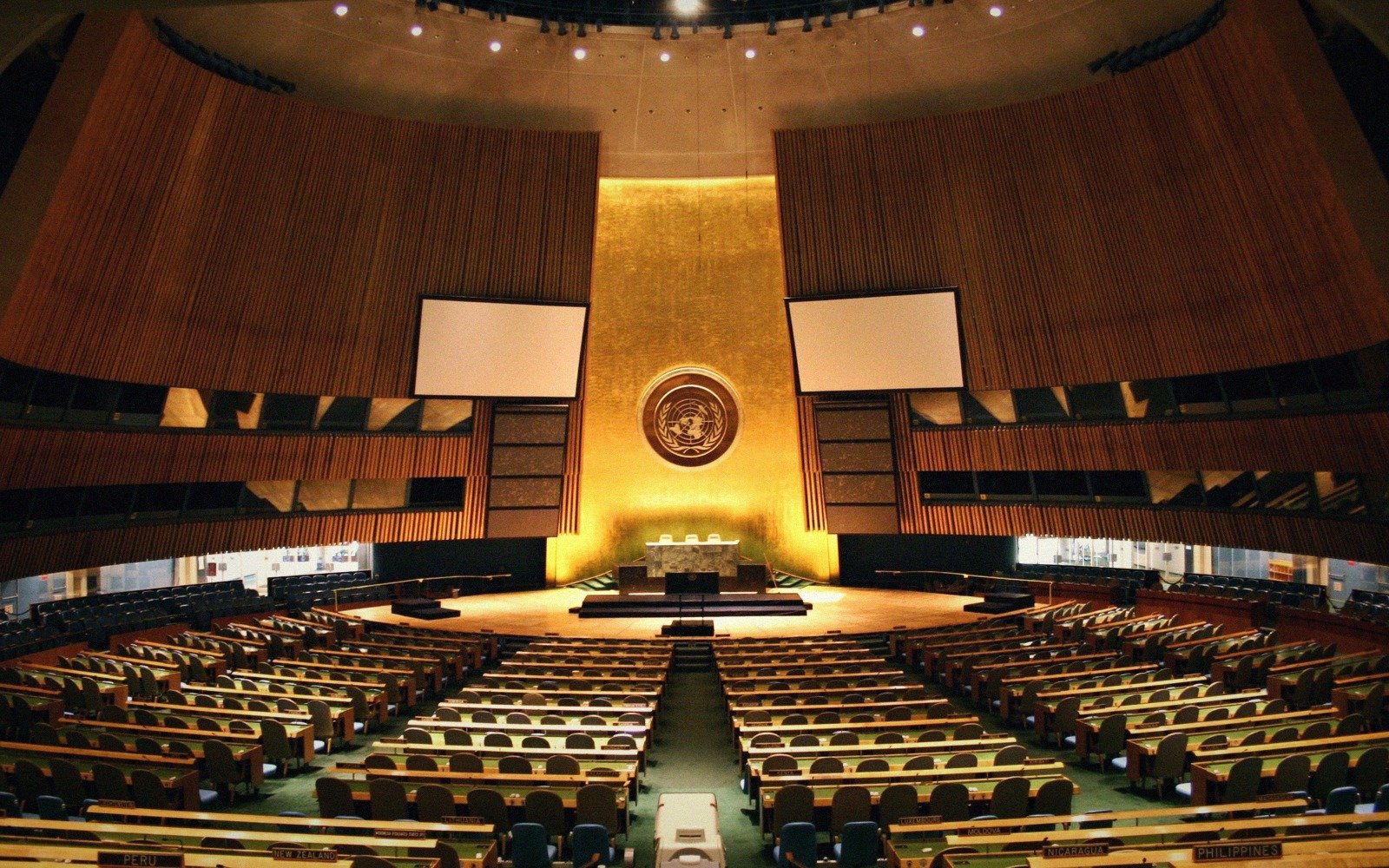
Silvia (Nicole Kidman1) returns to the United Nations Headquarters2 building after hours, through a back entrance she clearly knows well. She is an interpreter — the building is as familiar to her as a kitchen. She makes her way to the General Assembly3 chamber, settles into one of the glass-walled interpreter booths, and retrieves something she has left behind. While she is there, alone, the chamber dark and empty below her, two men enter the floor of the hall.
She cannot see them clearly. She can hear them perfectly. She is, after all, sitting at a microphone station designed to capture every syllable spoken on that floor.
128Minutes, running time
2005Year of release
1stFeature shot inside UN Headquarters
§02What the voices say
The two men speak in Ku — the invented language of the fictional African republic of Matobo — and this matters more than it might initially seem. Ku is not a major diplomatic language. Silvia is one of only a handful of people employed by the United Nations who speaks it fluently. The men on the floor below, speaking in Ku, believe they cannot be overheard in any consequential sense. It is their private code, and they are standing in a room that happens to be a listening machine.
What Silvia hears is a fragment of a conversation about a planned killing. The name she catches is Edmond Zuwanie — the elderly head of state of Matobo, played by Earl Cameron4 — who is shortly due to address the General Assembly in person. The nature of the plan, as she hears it, involves the General Assembly itself, the moment of Zuwanie's appearance, and a method the film deliberately leaves imprecise at this stage. She does not hear a complete operational briefing. She hears enough.
The critical detail is that the word she catches — the one that crystallises what she is hearing into an assassination plot rather than something more ambiguous — is a Ku word that she translates, later, as "genocide." The plan is not merely to kill Zuwanie, she understands, but to kill him in a way that would ignite something far larger back in Matobo. Whether the word she heard is the right word, whether her translation is reliable, whether her own history with Zuwanie colours what she hears and how she interprets it: these are the questions the film then spends the next hundred minutes refusing to settle cheaply.
The General Assembly hall — the room the scene is built around, and the film’s principal location.
§03The geometry of the scene and what it plants
What Pollack stages here is a geometry problem as much as a drama. The interpreter booths at the UN sit above and behind the main floor, separated by glass. Silvia can see the chamber from the waist up, depending on where the men stand; she cannot identify faces with certainty in the available light. She hears voices, not faces. She catches language, not identity. This is, in miniature, the entire epistemological problem of the film: interpretation is never a clean, lossless transfer. Something is always in the gap between the sound and its meaning.
The physical placement is also the source of her danger and her credibility problem simultaneously. Had she been on the floor, she would have been seen and the conversation would not have happened. Had she been anywhere else in the building, she would have heard nothing. The booth is the exact, unlikely position from which a partial truth can be received — partial enough to be deniable, complete enough to be terrifying.
Sydney Pollack5 holds on her face for a significant stretch after the voices go quiet and the men leave. This is characteristic of how the film handles its key moments — not cutting away, not rushing to the next plot beat, but staying with the person who has just absorbed something they cannot un-hear. Kidman is required to do a great deal of work in stillness here, and the scene depends entirely on the audience believing that what she is feeling is not calculation but shock. The film's argument that professional composure and genuine fear are not opposites rests on this beat.
Two professional listeners
Silvia Broome · interpreter
Tobin Keller · investigator
Trained to
Carry meaning across without adding to it.
Weigh what is said against what is withheld.
Listens for
Sense, register, the exact word.
Inconsistency, hesitation, motive.
Position
Above the floor, behind glass, unseen.
Across a desk, watching the face.
Weakness
She is not disinterested in Matobo.
His doubt outruns his evidence.
§04Why the overheard fragment is not a straightforward MacGuffin
A cruder thriller would use this scene as pure mechanism — a character hears a thing, now they are in danger, go. The Interpreter uses the overheard fragment to do something more structurally demanding. Silvia's past in Matobo, glimpsed in the film's prologue and disclosed in fragments across the middle act, establishes that she has personal, complicated reasons to want Zuwanie dead herself. Tobin Keller (Sean Penn6), the Secret Service agent assigned to investigate her account, is not simply wrestling with whether the threat is real. He is wrestling with whether the witness is reliable — and whether her reliability is separable from her motives.
This means the overheard fragment becomes contested testimony rather than established fact. The film does not ask you to doubt what Silvia heard, exactly. It asks you to think about what hearing something means when the hearer is not disinterested. The interpreter is always, in some sense, also the translated — her understanding of the Ku word she caught carries the weight of everything she has lived in Matobo. Her translation may be technically precise and emotionally loaded at the same time, and the film treats that duality with unusual seriousness.
There is also a layer of misdirection that the overheard scene quietly enables. Because we receive the fragment through Silvia's perception, we accept her translation of intent without question at first. The film gradually complicates this without discrediting her — a careful, uncommon move in a genre that usually needs its inciting incident to be simple and clean.
Beat 01After hours, she re-enters the General Assembly hall.
Beat 02Two men speak in Ku, the language of Matobo.
Beat 03She takes it as a threat against President Edmond Zuwanie.
Beat 04She reports it; the Secret Service takes the case.
Beat 05Agent Tobin Keller investigates the witness.
The film never supplies a recording or a second witness. Everything downstream of beat 03 rests on one person’s ear.
§05The scene's place in the whole
Strip out this scene and the film has no mechanism. But the scene is constructed to do more than start a plot — it establishes the film's central preoccupation with the limits of what language can carry and what proximity to truth actually confers. Silvia overhears because she is fluent in a language almost no one else at the United Nations speaks. That same fluency is inseparable from a life in Matobo that gives her reasons to misread, or to read all too clearly, depending on your view.
The invented Ku language is not an exotic detail but a structural necessity: if the men had been speaking French or Arabic, the overheard conversation would not have the same ambiguity. Any number of people could verify what was said. The scarcity of Ku speakers is what makes Silvia simultaneously the only witness and the unverifiable one.
For a scene that runs only a few minutes, it carries a remarkable amount of the film's weight — and it rewards rewatching, once you know how the picture ends, because the gap between what the audience hears and what Silvia hears is not quite as small as it first appears.
The fact plate
Field
Value
TITLE
THE INTERPRETER
YEAR
2005
DIRECTOR
SYDNEY POLLACK
RUNNING TIME
128 MIN
DISTRIBUTOR
UNIVERSAL PICTURES
CERTIFICATE
PG-13
LOCATION
UN HQ, NEW YORK
LANGUAGE (FICT.)
KU · MATOBO
Sources · channel 01
Reference works consulted for the names, places and production facts on this page. Numbered notes are marked in the text.