A director who trusted rooms and actors more than cutting.
The Making · 2 min read · 3 sections
The director who made tense rooms rather than tense sequences brought that discipline to his final thriller — and knew exactly what he had.
§01A Career Built on Containment
Sydney Pollack1 spent decades demonstrating that sustained dramatic pressure comes from faces in a room, not from intercutting. Three Days of the Condor, Tootsie, The Firm — each built its tension through people who couldn't quite trust each other, confined together by circumstance. The Interpreter, released in 2005, is the last film in that line, and it carries the full weight of the method.
By the time Pollack made it, he had earned a particular kind of authority: the authority to let a scene breathe. Where a more anxious director might cut to relieve pressure, Pollack held. The exchanges between Nicole Kidman2's Silvia Broome and Sean Penn3's Tobin Keller accumulate force precisely because neither character is rescued by an edit. Penn's stillness and Kidman's controlled precision play off each other across real space — and Pollack trusted both to fill it.
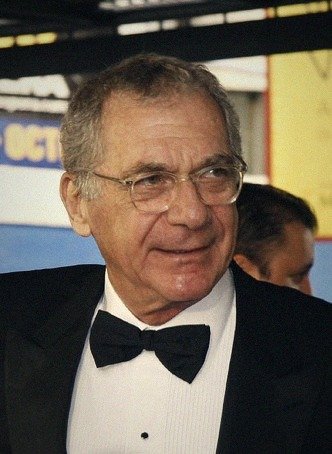
Sydney Pollack
Director
Directed The Interpreter, his last feature. He died in 2008.
Photograph via Wikipedia.
§02What the United Nations Changed
Gaining permission to shoot inside United Nations Headquarters was the production's defining logistical achievement, and Pollack used the access with the eye of someone who understood architecture as dramatic argument. The General Assembly4 chamber, the corridors, the translators' booths — these weren't backdrop. They were the film's argument made physical: a building designed for mediated speech, full of people whose job is to listen carefully and remain professionally absent.
That formal environment sharpened what Pollack already did naturally. He composed in depth, used long lenses to flatten characters against institutional surfaces, and kept music sparse. The UN interiors didn't force a style on the film; they confirmed one that was already his. When the camera finds characters across a corridor or through glass, it is doing what the building does — observing at a remove, uncertain whether what it's seeing is the truth.
§03A Finished Thing
Pollack died in 2008, three years after the film's release, and The Interpreter stands now as a clean endpoint. It doesn't feel like a director running out of ideas; it feels like one applying everything he'd learned about rooms, actors, and the specific discomfort of two intelligent people who want different things. There is no wasted energy in it. The film knows what it is: a political thriller that is, underneath, a character study conducted in one of the world's most self-consciously symbolic buildings.
Late work can be valedictory without meaning to be. The Interpreter is that, and it holds up.
Sources · channel 01
Reference works consulted for the names, places and production facts on this page. Numbered notes are marked in the text.