The permission, the conditions, and what filming there actually changed.
The Making · 4 min read · 3 sections
The first Hollywood feature to shoot inside United Nations Headquarters1 — and what it cost to get the keys.
§01The Permission
No fiction film had ever been granted access to film inside United Nations Headquarters before The Interpreter. That fact alone deserves a moment's pause. The UN is not shy about its image — it has hosted documentaries, news crews, public tours — but narrative fiction is another matter entirely. A thriller premised on murder, conspiracy and institutional failure at the UN was not, on its face, an easy sell to the organisation's leadership.
Sydney Pollack2 pursued the access over an extended period, making the case that a film treating the UN as a serious institution — not a backdrop for cartoonish villainy — was worth the risk. The argument, in essence, was that The Interpreter would portray the United Nations as a place where real, difficult work happens: translation, mediation, the grinding diplomacy of bodies that rarely satisfy anyone. Pollack's track record as a director of serious, adult films — not blockbuster spectacle — lent credibility to that pitch. The UN eventually agreed, under conditions that shaped every day of the shoot.
RequestedPermission to film inside United Nations Headquarters is sought for a commercial feature.
Refused, with a costly fallbackThe first approaches are turned down; a constructed set stands as the alternative.
Appealed directly to the Secretary-GeneralPollack takes the case to Kofi Annan in person.
Permitted, around the organisation’s own calendarThe unit shoots inside the building — the first feature ever allowed to do so.
§02The Conditions, and What They Demanded
The conditions were specific and non-trivial. Filming could only take place on weekends and after hours, when the building's actual diplomatic work was not in session. No scene could depict the United Nations itself as complicit in wrongdoing. The organisation retained consultation rights over how it was represented. These were not trivial constraints on a production; they required the entire shooting schedule for the UN sequences to be compressed into a narrow band of available time, working around the rhythms of an institution that does not pause for the convenience of film crews.
What Universal Pictures and the production got in return was irreplaceable: the General Assembly3 Hall, the Security Council chamber, the long interior corridors with their particular quality of light. These are not spaces that can be convincingly replicated on a stage. The ceiling heights, the acoustic quality, the specific geometry of rooms designed for simultaneous translation — all of it reads on screen as authentic precisely because it is. Production designers can approximate many things; they cannot easily fake forty years of institutional wear and the gravitational weight of a room where actual resolutions have been passed.
The restriction against depicting the UN as institutionally corrupt was the most dramatically significant condition. It meant the film's conspiracy had to be located elsewhere — among individuals, private actors, émigré politics — rather than within the organisation's own machinery. This is not only a diplomatic concession; it becomes, arguably, a structural feature of the film's politics. The UN in The Interpreter is a space in which bad things can happen without the institution itself being the villain, which is a more complex and perhaps more honest position than most political thrillers take.
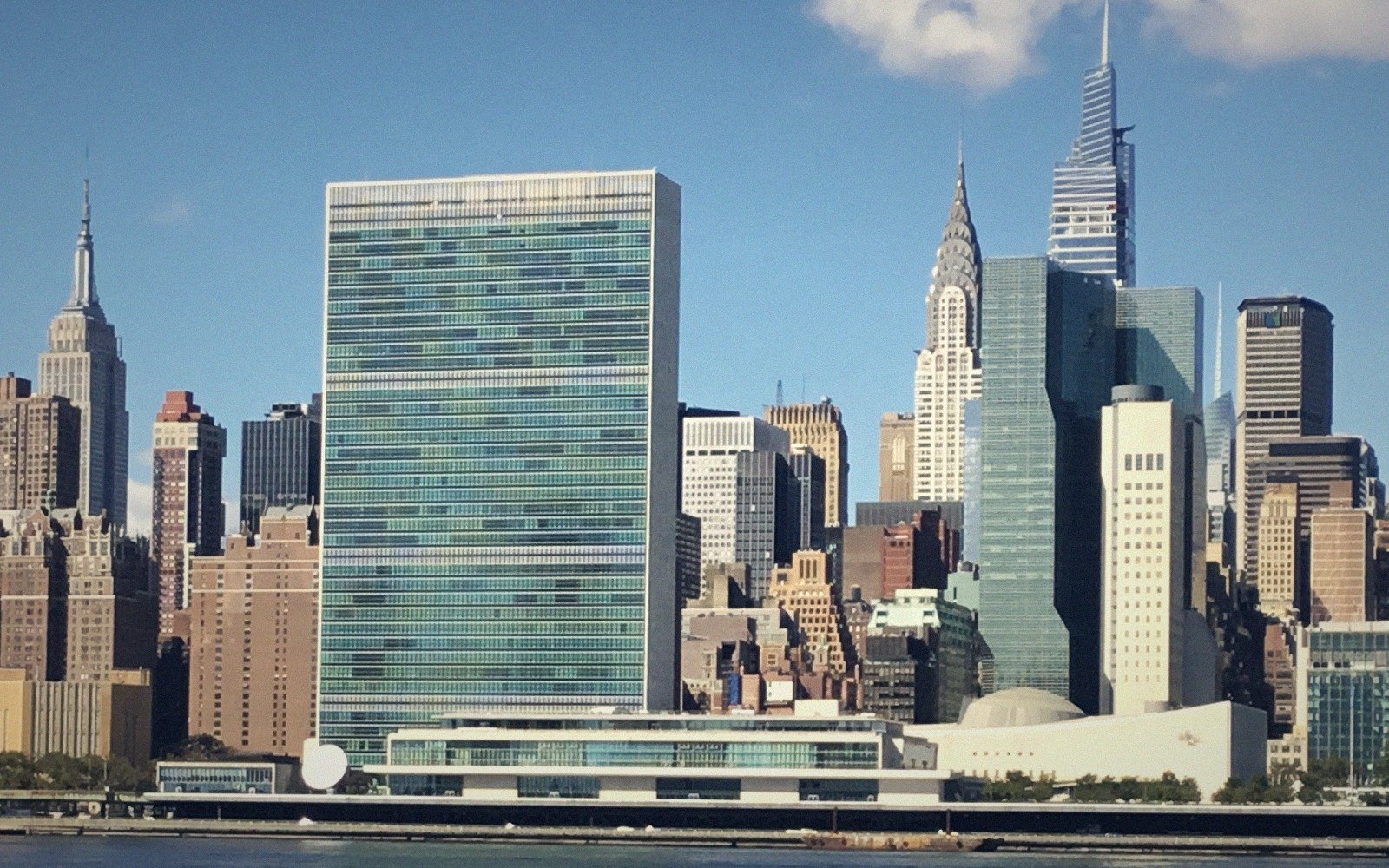
United Nations Headquarters, New York — the real building, and the reason the film’s distances feel imposed rather than designed.
§03What Filming There Actually Changed
The effect on the performances is difficult to overstate. When Nicole Kidman4's Silvia Broome moves through the General Assembly booth, or when Sean Penn5's Tobin Keller conducts interviews in the building's functional spaces, the actors are responding to real rooms. That is not a trivial thing. Kidman has spoken in general terms about the way real environments influence the body and the voice differently than constructed sets; in a film where Silvia's entire professional identity is tied to the act of listening and translation, the acoustic reality of those booths matters.
Pollack, whose method consistently prioritised performance over visual effect, used the real location to keep the film's tone grounded. The UN's particular institutional aesthetic — the muted palettes, the long sight lines, the slightly faded internationalism of mid-century modernist design — gave his cinematographer a visual grammar that could not have been fabricated cheaply or quickly. The result is that the building functions almost as a third character: neutral, enormous, indifferent to the human drama unfolding inside it.
There is also the matter of what the access signalled to the rest of the production. Getting inside the UN required that the film be taken seriously by people whose instinct is to refuse. That seriousness permeated the work. The cast, the crew, the screenplay — all of it was operating under the implicit pressure of having been trusted with something real. Whether that pressure produced better filmmaking is impossible to measure cleanly, but it is not nothing.
The Interpreter remains the only Hollywood fiction feature to have filmed inside United Nations Headquarters. That distinction has held since 2005 and shows no sign of changing. Whatever its critical fortunes — and its reception was contested — the film earned its location in a literal sense, persuading one of the world's most scrutinised institutions to open a door it had kept shut. What Pollack and his company brought back through that door is on screen: real rooms, real light, the specific gravity of a building where the world's most intractable problems go to be talked about.
Sources · channel 01
Reference works consulted for the names, places and production facts on this page. Numbered notes are marked in the text.