Building a fictional African language, and why the film needed one.
The Making · 6 min read · 5 sections
§01Why a fictional country needed a real language
Silvia Broome is an interpreter at the United Nations. Her professional identity depends entirely on language — on the ability to move between tongues so fluidly that her own presence disappears. When the film needs her to overhear something she was never meant to hear, it faces an immediate problem: what language does she overhear it in?
The answer shapes the film more than it might appear. Had the filmmakers placed Matobo — the fictional southern African republic at the heart of the story — inside an existing country with an existing language, they would have inherited a political context they couldn't fully control. A real nation, a real language, a real historical grievance: the film would have been making claims it wasn't equipped, or willing, to make. The solution was to invent everything from the ground up: country, leader, atrocity and, crucially, the language spoken there. That language is Ku, and it is not a prop. It is a constructed tongue built with enough internal consistency to be learned, spoken and heard as plausible by anyone who listens carefully.
§02Building Ku: the linguistic work behind the screen
Constructed languages — conlangs, in the shorthand of the field — have a longer history in film and television than most viewers realise. What distinguishes Ku from a simple collection of invented syllables is that it was developed with reference to actual Bantu language structures. The Bantu family is the largest language group in sub-Saharan Africa, spoken in various forms across a vast belt running from Cameroon in the west through East Africa and down into southern Africa. Matobo, as a fictional nation in that southern region, called for something that would sound aurally coherent to audiences familiar with African languages without reproducing any one of them.
The linguistic consultant work on Ku involved establishing consistent phonological rules — how sounds combine, which consonants appear in which positions, what the prosody of the language feels like in the mouth of a native speaker. Languages are not just vocabularies; they are systems, and an invented language that lacks a system falls apart the moment a trained ear hears it. Nicole Kidman1, as Silvia Broome, needed to speak Ku not as an approximation but as someone for whom it is a mother tongue. That demanded a language that behaved like one.
For Kidman, the preparation was extensive. Silvia grew up in Matobo, speaks Ku as a first language, and her relationship to it is soaked in loss — her parents, her history, her compromised past are all encoded in it. A character who is professionally a language specialist, and personally defined by a language the audience cannot understand, requires the actor to perform fluency rather than simulate it. Any inconsistency in pronunciation, any hesitation that doesn't belong to the character, would register as false. The linguistic groundwork was therefore not merely atmospheric but structurally necessary to the performance.
§03What the language does for the film
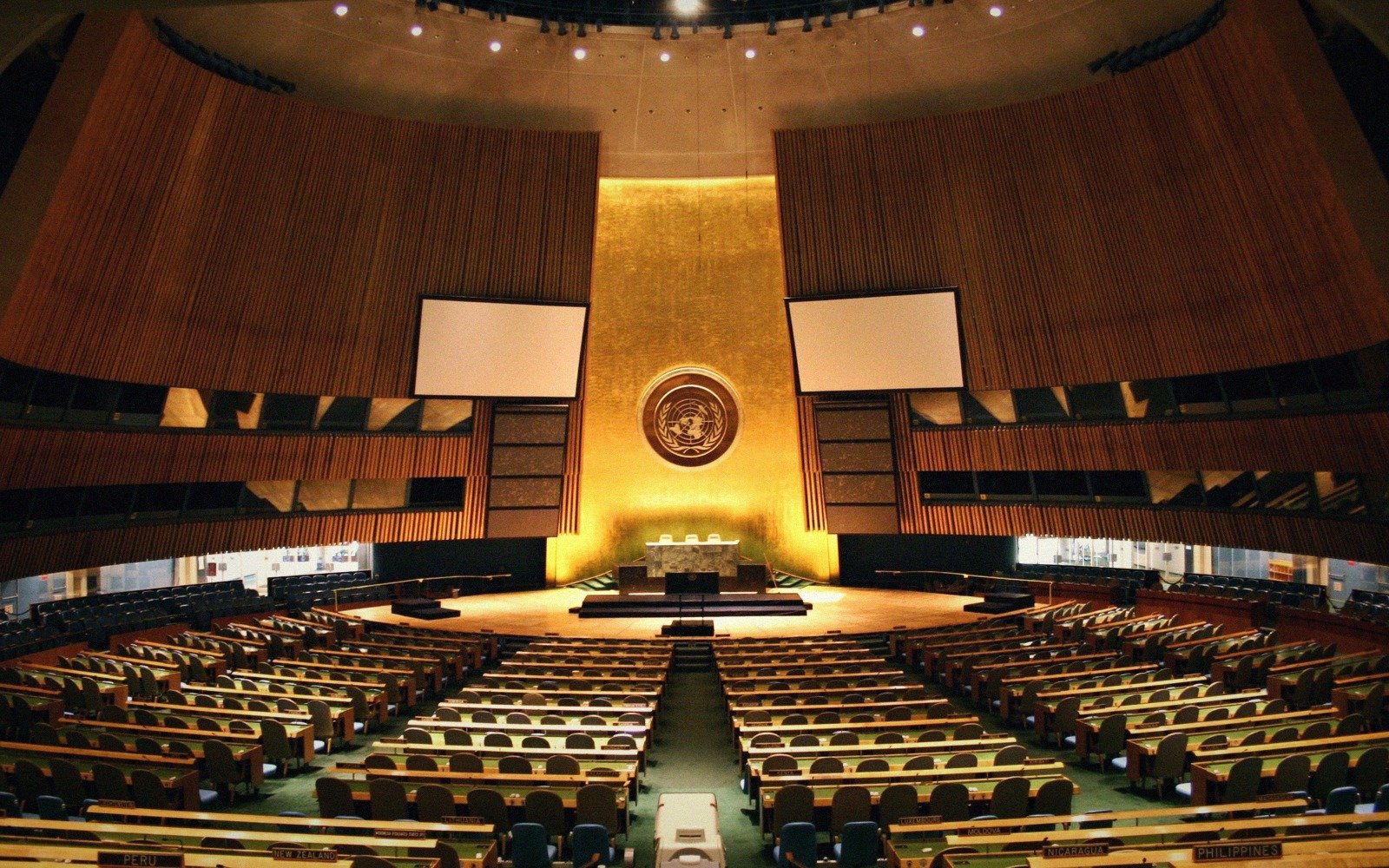
The most immediate function of Ku is to create an information gap. When Silvia returns to her booth late one night and overhears two men speaking in the General Assembly2 chamber below, the audience is in exactly her position: we understand nothing, then fragments, then the shape of something terrible. The scene depends entirely on this layered comprehension — Silvia's dawning horror is also ours, and it only works if the language is genuinely opaque to the viewer. Had the filmmakers used a real African language, a portion of the audience would have followed the conversation without Silvia's mediation. Ku seals that gap completely.
But Ku does more than withhold information. It establishes Silvia's interiority in a way that English cannot. When she speaks it — in the early scenes on the roof, in private moments, in the charged exchanges that reveal pieces of her past — the language functions as a register of intimacy and grief. Her English is fluent and precise; it is the language of her professional life, of self-discipline, of the careful persona she maintains inside the United Nations building. Ku is something else. It carries the texture of a world before the corruption of Zuwanie's regime, before exile, before the choices she made that now complicate her credibility as a witness. A language that exists nowhere else in the world is a language that belongs entirely to her — and to the people who, by the time of the film, are largely dead.
This gives Ku an elegiac weight that a real language, with its living speakers and ongoing politics, could not carry in the same way. Sydney Pollack3 and his writers needed a language that could be possessed by grief without those feelings colliding with the actual circumstances of any real community. Invention was not evasion; it was precision.
Matobo, its president and its language are inventions. Everything on this site about the real production is not.
§04The fictional country and why the language had to match it
Matobo is drawn with some care. It has a geography — landlocked, southern African — a political history involving colonial withdrawal, a post-independence leader who became a tyrant, and an ethnic dimension to its violence that echoes, without directly reproducing, several real African catastrophes of the twentieth century. Earl Cameron4's Edmond Zuwanie is a man who led a liberation movement and then turned on the people he claimed to liberate: a recognisable archetype, placed at enough distance from any single event that the film can be morally serious without being journalistically specific.
For that construct to function, Matobo needed cultural texture, and language is the most intimate form of cultural texture there is. A fictional country with a real language is always slightly unstable — the real language pulls toward its actual speakers, its actual geography, its actual history. Ku anchors Matobo as a self-contained invention. It allows the film to say: this is not Rwanda, not Zimbabwe, not any specific place, but it is drawn from the same human realities. The distance is the point.
There is also a practical dimension. A production as high-profile as this one — Universal Pictures, a director of Pollack's stature, two of the most scrutinised actors of their generation — would have faced significant pressure had it placed its fictional genocide inside a real nation. The use of a constructed language was, among other things, a form of respect: an acknowledgment that real atrocities belong to the people who survived them, and that a Hollywood thriller, however well-intentioned, should not colonise that specific ground.
§05What Ku leaves with the viewer
Languages are how films establish that a world exists beyond the frame. Ku does exactly that for Matobo. It is heard in fragments, translated imperfectly, felt in Silvia's silences when English fails to carry what she means. By the film's end, the audience has not learned a word of it, and yet the language has done its work — it has made the loss real, given the politics a human scale, and provided a performance with roots that go somewhere the camera cannot follow.
That is, ultimately, why a thriller about international politics and a UN interpreter needed an invented language rather than a borrowed one. The film's emotional architecture required something that could be wholly owned by its characters, wholly shaped for their specific grief. Ku is not decoration. It is the medium through which the film's central character carries everything she cannot say.
Sources · channel 01
Reference works consulted for the names, places and production facts on this page. Numbered notes are marked in the text.